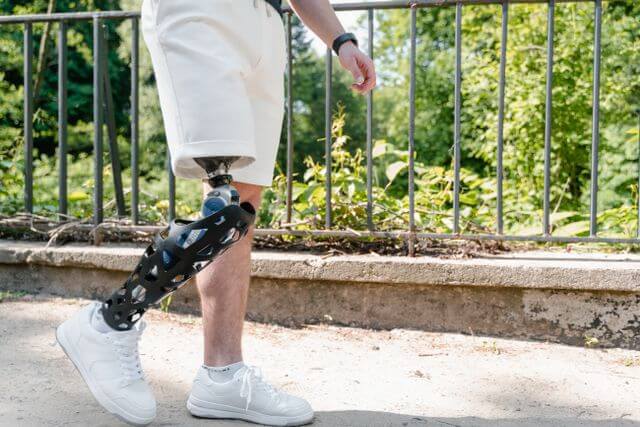
Losing part of a leg reshapes the smallest routines first. Getting out of bed, crossing a kitchen, standing long enough to cook dinner: these are the things that change overnight. For most people, though, those routines come back. A well-built prosthetic limb, paired with steady rehabilitation, allows the majority of lower-limb amputees to walk again and return to work, family life, and the activities that matter to them.
What surprises many newcomers is how much thought goes into a single artificial leg. It is not a product pulled off a shelf. It is a clinical solution shaped around one person’s anatomy, health history, and goals, and it keeps evolving over the months and years that follow. This guide walks through how lower-limb prosthetics are designed, the decisions behind them, and what getting fitted actually involves.
No Two Legs Are Built the Same
The starting point for any device is the residual limb, the part of the leg that remains after surgery. Its length, shape, skin condition, and how much soft tissue covers the bone all influence what comes next. Two people with the same level of amputation can need very different setups, because one might have a long, well-padded residual limb and the other a short, bony one that needs careful cushioning.
That is why a custom prosthetic leg is built around the individual rather than a generic template. A prosthetist takes detailed measurements, often using a cast or a digital scan, and uses them to shape a socket that fits snugly without rubbing or pinching. A few millimeters in either direction can be the difference between comfortable all-day wear and a sore that keeps someone off their feet. Fit is not a finishing touch on a prosthesis; it is the foundation everything else sits on.
What Leads to Lower-Limb Amputation
People arrive at a prosthetic clinic by very different routes, and the reason behind an amputation shapes the care that follows. The most common cause of lower-limb loss is poor circulation linked to vascular disease and diabetes, where reduced blood flow and nerve damage let wounds develop and resist healing. Trauma from accidents is another frequent cause, often affecting younger and otherwise healthy people. Severe infection, certain cancers, and limb differences present from birth round out the picture.
Why this matters is practical. A person whose amputation stemmed from diabetes usually needs ongoing attention to circulation and skin health, and the remaining limb has to be protected carefully. Someone who lost a limb to trauma may heal faster but carry other injuries that affect rehabilitation. The cause also influences how stable the residual limb will be and how quickly a person can progress, so a good prosthetist factors all of it into the plan rather than treating every case the same way.
Understanding the Levels of Amputation
Where the amputation occurs has a large effect on the design and on how a person walks afterward. Clinicians group lower-limb amputations into several broad levels, and each one preserves a different amount of natural function.
At the lowest level are partial foot amputations, which remove one or more toes or a section of the forefoot. People at this level usually keep their own ankle and heel, so the rehabilitation challenge is mostly about balance, pressure distribution, and protecting the remaining tissue. Below-knee, or transtibial, amputation is one of the most common levels. Keeping the natural knee joint is a major advantage, because the knee does so much of the work in walking and is hard to replace mechanically. Above-knee, or transfemoral, amputation removes the knee, which means the prosthesis has to recreate that joint’s movement. Higher still are knee disarticulation, hip disarticulation, and pelvic-level amputations, which call for the most complex devices.
The practical takeaway is simple. The more natural joints a person keeps, the more of the original movement the body can do on its own, and the less the prosthesis has to compensate for.
Matching the Device to Daily Life
A prosthesis is only useful if it fits the life the person actually leads. Someone who walks short distances at home has different needs from a parent chasing children around a yard or a tradesperson on their feet for ten hours. Clinicians often describe these differences using functional levels, a rating system that runs from no ability to walk up to high-impact activity. The functional level helps guide which components are appropriate and which would be either overkill or not enough.
This is where the breadth of available options matters. A person with a forefoot amputation might do well with a partial foot prosthetic and a custom insert that restores the length and push-off of the missing section, while someone with a higher amputation needs a full limb with a socket, knee, and foot working together. The goal is never the most advanced device on the market. It is the device that lets a specific person move the way they want to, with the least effort and the lowest risk of injury.
Lifestyle questions shape these choices in concrete ways. How far does the person walk in a typical day? Do they climb stairs, kneel, or carry loads? Do they want to return to a sport or a physically demanding job? Honest answers to those questions produce a far better outcome than guessing, because every component added to a leg has trade-offs in weight, cost, durability, and maintenance.
Inside a Modern Prosthesis
A lower-limb prosthesis is a small system of parts, each doing a job. Understanding them takes the mystery out of the process.
The socket is the interface between the body and the device. It cradles the residual limb and transfers the forces of walking into the prosthesis. Most people wear a liner inside the socket, usually made of silicone or gel, which acts like a second skin to reduce friction and absorb shock. Suspension is the method that keeps the limb attached, ranging from suction and vacuum systems to pin locks that click into place.
Below the socket sits a pylon, the structural connector that links everything to the foot. Prosthetic feet vary widely. Basic feet provide stable, predictable support, while dynamic-response feet made from carbon fiber store and release energy with each step, giving a springier, more efficient gait. For above-knee users, a prosthetic knee joint is added. These range from simple mechanical hinges to microprocessor-controlled knees that read movement many times per second and adjust resistance to make walking safer and smoother, especially on stairs and uneven ground.
None of these parts works in isolation. The art of prosthetics lies in combining them and then aligning them so the whole limb moves as one coordinated unit.
Fitting, Alignment, and Learning to Walk Again
Getting a prosthesis is a process, not a single appointment. In the weeks after surgery, the residual limb is swollen and changes shape as it heals. Many people wear a compression garment called a shrinker to help the limb settle into a stable form before the first socket is made.
Once the limb is ready, the prosthetist creates a check socket, a temporary version used to test and refine the fit. Adjustments happen here, sometimes several rounds of them, before the definitive socket is finalized. Then comes alignment, the careful positioning of the foot and knee relative to the socket so that the person stands and walks in balance. Poor alignment forces the body to compensate, which leads to fatigue and back or hip pain over time.
Physical therapy runs alongside all of this. Early sessions focus on standing, shifting weight, and taking the first supported steps. Gradually a person builds the strength, balance, and confidence to walk without aids. The pace varies a great deal. Age, overall health, the level of amputation, and motivation all play a part, and there is no single timeline that fits everyone. What matters is steady, guided progress rather than rushing.
It also helps to know that the first prosthesis a person receives is rarely their last word on the matter. As the residual limb matures and walking improves, needs often change, and components that suited the early weeks may give way to others better matched to a more confident, active gait. Treating the first limb as a starting point rather than a permanent verdict tends to reduce frustration when adjustments prove necessary.
The Long View: Living With a Prosthesis
A prosthetic leg is not a one-time purchase. The residual limb continues to change, particularly in the first year, as muscle tone and fluid levels shift. People manage minor day-to-day changes by adding or removing thin sock layers to fine-tune the fit, and they return to their prosthetist when larger adjustments or a new socket are needed.
Daily care protects both the device and the skin. Checking the residual limb for redness or irritation, keeping the liner clean, and watching for any sore that does not fade quickly are habits worth building early. Comfort and skin health, not the technology, are usually what determine how much someone actually wears their limb.
Phantom sensations, including the feeling that the missing part is still there and sometimes phantom pain, are common and normal. They tend to ease over time, and there are recognized ways to manage them. Just as important is the emotional side of adapting. Connecting with others who have been through the same experience often helps people set realistic expectations and stay motivated through the slower stretches of recovery.
Practical questions about cost and coverage come up early and deserve straight answers. Prosthetic limbs and their components vary widely in price, and what insurance covers depends on the plan, the documented medical need, and the person’s functional level. Because of this, the care team’s documentation of goals and abilities is not just paperwork; it directly affects which components can be justified and approved. Planning for periodic replacement is wise too, since sockets and components wear and the body changes, and most people can expect to update parts of their setup over the years.
The broad picture is encouraging. With a properly fitted limb, sound rehabilitation, and regular follow-up, most people with lower-limb amputations return to a full and independent life. The technology keeps improving, but the fundamentals have not changed: a good fit, a device matched to real goals, and a patient who is supported through the learning curve. Those three things, more than any single component, decide how well someone moves on their new leg.


