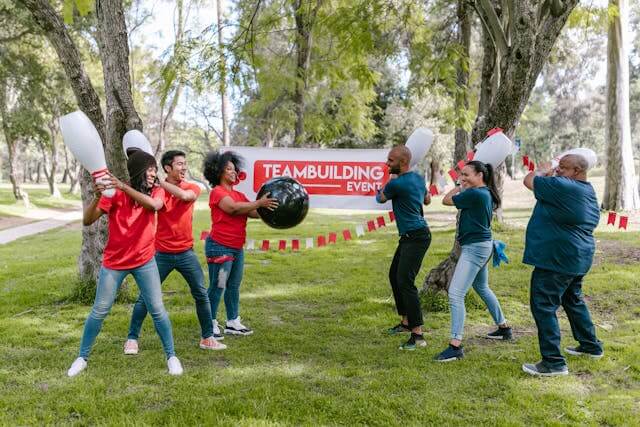
Corporate teams in Montreal are trading fluorescent lighting for fresh air. Outdoor team building creates shared physical and cognitive challenges that cubicle-based icebreakers cannot match, and Montreal’s mix of riverfront parks, mountain trails, and year-round seasonal programming gives organizers a deep menu of options. This guide covers the science behind outdoor group activities, the best formats for different team sizes, venue options across the city, and a step-by-step planning framework.
Why Outdoor Team Building Delivers Stronger Results Than Indoor Alternatives
How Does Physical Activity Influence Team Cohesion?
Movement changes how people interact. When colleagues walk, run, or paddle together, the shared effort builds trust and positive social bonding faster than seated meetings ever could. Physical tasks also level the playing field: job titles carry less weight when everyone is learning to steer a dragon boat for the first time.
Shared physical effort creates a natural sense of group rhythm. Teams that move in coordination report higher levels of cooperation in follow-up tasks. For corporate teams, this translates into smoother cross-departmental collaboration once everyone returns to the office.
Finding activities that balance physical engagement with strategic value takes research and coordination. Companies like Spiniko facilitate teambuilding activities Montreal corporate groups can experience across the city’s parks and outdoor venues, removing the logistical burden so organizers can focus on team objectives rather than event planning.
What Role Does Environment Play in Group Problem-Solving?
Indoor meeting rooms prime people for routine thinking. Outdoor settings break that pattern. Open spaces give people room to think more freely and encourage divergent thinking, the type of ideation that produces creative solutions rather than safe defaults.
Montreal’s geography amplifies this effect. A team solving a navigation challenge on the Lachine Canal processes spatial, social, and strategic information simultaneously. That multi-layered engagement reinforces collaborative decision-making habits, something a boardroom whiteboard session rarely achieves.
What Types of Outdoor Team Building Activities Work Best in Montreal?
Challenge-Based Activities: Scavenger Hunts, Obstacle Courses, and Relay Races
Challenge-based formats work best when the goal is friendly competition and rapid bonding. Scavenger hunts through Old Montreal combine navigation, trivia, and time pressure into a single event. Obstacle courses at outdoor parks like Parc Jean-Drapeau push teams to strategize under physical constraints. Relay races add a scoring element that keeps energy high across multiple rounds.
These formats suit groups that thrive on clear objectives and measurable outcomes. They also scale well: a scavenger hunt that works for 15 people can be restructured into multi-team brackets for 100+.
Collaborative Experiences: Group Sports, Paddling, and Adventure Circuits
Collaboration-first activities shift the focus from winning to coordinating. Dragon boating on the St. Lawrence requires synchronized paddling across 20 seats. Group cycling tours through the city’s 900+ km bike network demand pace-matching and route communication. Adventure circuits that rotate stations (climbing wall, archery, rope bridge) force teams to adapt their strategy at each stop.
These experiences suit teams that need to rebuild trust or integrate new members. The shared challenge of trying something unfamiliar builds team trust faster than any structured workshop.
Low-Intensity Options: Walking Workshops, Park Picnics, and Reflection Sessions
Not every team event needs a high-energy format. Walking workshops on Mount Royal pair structured discussion prompts with a 45-minute loop trail. Park picnics with facilitated conversation games let quieter team members contribute on equal footing. Guided reflection sessions in green spaces help reset group dynamics before a busy quarter.
Low-intensity formats are ideal for senior leadership retreats, post-merger integration events, or teams coming out of high-pressure project cycles.
How to Choose the Right Outdoor Activity for Your Team Size and Goals
What Should You Consider When Planning for Groups Under 30?
Small groups benefit from activities that maximize individual participation. With fewer than 30 people, every person can speak, contribute, and be visible. Single-team scavenger hunts, guided canoe trips, and collaborative cooking challenges over open-fire setups all work well at this scale.
The key variable is objective. If the goal is bonding, choose an activity with built-in downtime (picnic, walking workshop). If the goal is performance, choose a timed challenge with clear scoring.
Scaling Outdoor Events for 50+ Participants
Large groups need structure to avoid chaos. The most effective approach is a multi-station rotation model: divide participants into teams of 8-12, assign each team a starting station, and rotate every 20-30 minutes. This keeps engagement high and prevents the “spectator effect” where half the group watches while the other half participates.
Logistics matter more at scale. Assign team captains before the event, pre-print maps and schedules, and build 15-minute buffer windows between rotations. A dedicated event coordinator (separate from the host) should manage timing and troubleshoot on the ground.
Where to Host Outdoor Team Building Events in Montreal
Parks and Green Spaces: Parc Jean-Drapeau, Mount Royal, and Old Port
Parc Jean-Drapeau offers 268 hectares of island terrain with open fields, wooded trails, and waterfront access. It handles large groups without overcrowding and includes on-site facilities for post-event gatherings. Mount Royal provides elevation, forest cover, and panoramic viewpoints that anchor memorable team photos. The Old Port combines cobblestone walkways, the Lachine Canal, and proximity to restaurants for post-event dining.
Each venue serves a different tone. Jean-Drapeau suits high-energy athletic events. Mount Royal fits reflective and exploratory formats. Old Port works for culture-forward scavenger hunts and walking tours.
Waterfront and Seasonal Venues
Montreal’s waterfront opens up paddling, sailing, and beach volleyball options from May through October. The Lachine Canal is the most accessible flatwater route for dragon boating and kayaking. In winter, outdoor skating circuits, snowshoeing on Mount Royal, and ice sculpture challenges keep programming alive 12 months a year.
Seasonal variety is a genuine advantage. Teams that run quarterly outdoor events can offer a completely different experience each time without repeating a venue or format.
How to Plan a Successful Outdoor Team Building Event Step by Step
Setting Objectives and Defining Success Metrics Before the Day
Start with the outcome, not the activity. Ask 3 questions before booking anything: What behaviour change do we want to see after this event? How will we measure it? What constraints (budget, mobility, weather) limit our options?
Common objectives include improving cross-team communication, onboarding new hires, celebrating a milestone, or resetting morale after a difficult quarter. Each objective points to a different activity format. Define the metric (post-event survey score, participation rate, follow-up collaboration frequency) before choosing the venue.
Logistics Checklist: Permits, Weather Contingencies, and Equipment
Outdoor events carry variables that indoor events do not. Build a logistics checklist that covers:
- Permits: Parc Jean-Drapeau and Mount Royal require group activity permits for events over 25 people. Apply 3-4 weeks in advance.
- Weather plan: Book an indoor backup venue or rent a covered pavilion. Set a “go/no-go” decision point 48 hours before the event.
- Equipment: Confirm who supplies materials (facilitator vs. company). Portable speakers, first aid kits, water stations, and sunscreen are baseline requirements for any outdoor event over 2 hours.
- Transportation: Arrange group transit if the venue is outside downtown. Shared buses reduce parking headaches and build pre-event energy.
- Accessibility: Verify that the venue and activity accommodate all mobility levels. Offer alternative participation roles for anyone who cannot complete physical tasks.
What Montreal Companies Get Wrong About Outdoor Team Building
Common Pitfalls That Reduce Engagement and ROI
The most frequent mistake is treating team building as a reward rather than a strategic investment. Events without clear objectives generate fun memories but zero behavioural change. The second mistake is over-scheduling: packing 6 hours with back-to-back activities drains energy and kills the organic conversations that produce real bonding.
Other common errors include ignoring dietary and accessibility needs, choosing activities that favour athletic employees over everyone else, and skipping the post-event debrief. A 15-minute structured reflection at the end of the day doubles retention of lessons learned compared to ending cold.
Key Takeaways for Building Stronger Teams Outside the Office
Outdoor team building works because it disrupts routine, engages the body alongside the mind, and creates shared reference points that carry back into daily work. Montreal’s park system, waterfront access, and 4-season climate make it one of the strongest cities in Canada for year-round corporate programming.
The formula is straightforward: define the objective, match the activity to the team’s size and culture, handle logistics early, and close with a debrief. Companies that treat outdoor events as recurring investments rather than one-off perks see measurable gains in retention, collaboration, and employee satisfaction.
Frequently Asked Questions About Outdoor Team Building in Montreal
What Is the Best Time of Year for Outdoor Team Building in Montreal?
Late May through early October offers the widest range of activities, with June and September providing the most comfortable temperatures for full-day events. Winter programming (December through March) is viable with cold-weather formats like snowshoeing, skating, and ice challenges, though sessions should be shorter (2-3 hours max) to manage comfort.
How Much Does an Outdoor Team Building Event Cost in Montreal?
Costs vary by format and group size. Self-organized park events with minimal equipment can run under 500 $ for a group of 20. Fully facilitated experiences with professional coordinators, equipment, and catering typically range from 50 $ to 150 $ per person. Premium multi-activity days with transportation and venue rental can reach 200 $+ per person.
Can Outdoor Team Building Activities Be Adapted for Remote or Hybrid Teams?
Yes. Hybrid formats pair an on-site outdoor activity with a live-streamed component for remote participants. Scavenger hunts work particularly well: on-site teams complete physical checkpoints while remote teammates solve digital clues via video call. Walking workshops can include remote participants through headset-connected audio channels. The key is designing tasks where both groups contribute to a shared outcome rather than treating remote attendees as spectators.


