The digital space for manufacturers is shifting rapidly, with website design now playing a pivotal role in how companies attract new business, support existing clients, and stay ahead of industry changes. In today’s highly competitive manufacturing landscape, customers and partners alike expect seamless, informative, and engaging online experiences before initiating any form of contact.
Enhanced online experiences are increasingly the expectation rather than the exception, and this applies just as much to small- to mid-size manufacturers as to global industrial giants. As companies navigate this continuous evolution, partnering with an industrial website design agency provides the expertise to implement next-generation web solutions tailored to the specific challenges and opportunities manufacturers face. With digitalization at its core, effective web design can shape business outcomes, from first impressions to seamless after-sales engagement, giving manufacturers the tools to foster stronger relationships, close deals faster, and strengthen their reputations within and beyond the sector.
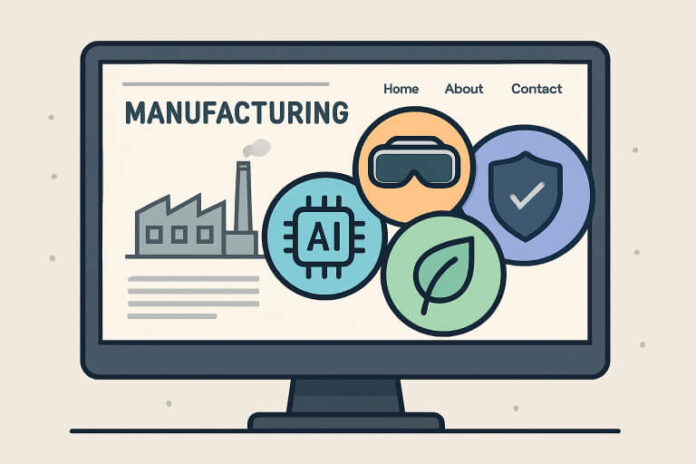
Forward-thinking manufacturers recognize that staying up to date with website trends isn’t just about aesthetics—it’s fundamentally tied to operational efficiency and strategic growth. Today’s digital ecosystem demands that manufacturers integrate design, usability, and digital functionality to meet diverse and evolving needs. Emerging design directions like AI-driven personalization, immersive AR and VR implementations, a shift to sustainable web practices, and robust cybersecurity are redefining how manufacturing businesses serve both B2B and B2C audiences. These digital innovations can help businesses streamline operations, foster transparency, and even reduce overheads, signaling a new era of connected manufacturing. With an ever-more challenging and dynamic supply chain, innovative web design becomes central not only to customer acquisition but to ongoing process improvement, technical support, and future-proofing against competitor advances.
AI and Automation in User Experience
Artificial Intelligence (AI) and automation are revolutionizing manufacturers’ digital presence. By leveraging machine learning algorithms and intelligent analytics, these technologies create tailored user experiences by analyzing user behavior, customizing product recommendations, and automatically surfacing relevant content based on individual visitor profiles. AI-powered chatbots are transforming customer support, resolving queries around the clock and facilitating everything from technical troubleshooting to product navigation across extensive industrial inventories. These bots are often capable of sophisticated natural language processing, enabling them to understand complex questions and escalate issues to human agents when necessary. According to Business News Daily, AI is increasingly a critical driver of business trends, helping companies stay competitive by delivering more innovative, faster digital solutions.
Automation stretches beyond the surface, enabling robust backend management and integration with ERP and CRM systems. Advanced platforms automatically update certifications, technical documentation, and product specs, ensuring accuracy while freeing up human resources for higher-value tasks, such as business development and engineering innovation. From automated quote generation to predictive maintenance scheduling, automation reshapes the manufacturer’s web presence into a strategic business asset. Businesses that leverage automation not only deliver faster, more relevant experiences but also set themselves apart in an industry where every second and detail matters. The result is a website that works as efficiently as the production line itself, streamlining the journey from initial inquiry to purchase and beyond.
Augmented and Virtual Reality Integration
Augmented Reality (AR) and Virtual Reality (VR) are setting new standards for engagement on manufacturing websites. Through immersive 3D product modeling and interactive environments, customers can better assess fit, scale, and usability—reducing costly returns and streamlining procurement cycles. For complex, high-value industrial investments, these technologies deliver a “try-before-you-buy” experience, letting clients manipulate equipment, test configurations, or visualize installations in their own environments using just a browser or mobile device. Virtual plant tours and real-time machine demonstrations can offer insights that traditional imagery cannot, bringing transparency and clarity that inspire confidence in decision-makers and end users alike.
Manufacturers are also benefiting from VR simulations for technical training, enabling partners and customers to understand complex machinery without being on-site. By providing interactive, remote access to operational walkthroughs and maintenance tutorials, companies can shorten onboarding times and support international stakeholders without requiring as much travel. This not only accelerates the sales cycle but also supports after-sales and tech-support processes for global client bases, highlighting the versatility of AR/VR technologies across the manufacturing value chain. These immersive tools can also make websites memorable and differentiate brands, strengthening competitive positioning in a crowded digital marketplace.
Sustainable Web Design Practices
The manufacturing sector is increasingly aligning its digital strategies with broader sustainability goals—a shift driven by regulatory changes, customer expectations, and a genuine commitment to environmental stewardship. Sustainable web design starts with efficient coding and streamlined visuals that reduce server load and energy consumption, resulting in lower power use and lower operational costs. By minimizing the use of high-resolution media and enhancing site performance, businesses actively reduce their carbon footprints. Hosting websites on renewable-energy-powered servers makes a substantial difference, as does the transition to lightweight frameworks and optimized content delivery networks that scale intelligently in response to traffic fluctuations.
Beyond infrastructure, sustainable web design also communicates a corporate commitment to environmental responsibility to environmentally conscious customers, partners, and regulators. Incorporating sustainability badges, sharing green initiatives, and integrating real-time energy dashboards into digital platforms are becoming standard practices for manufacturers who want to lead by example. Green web initiatives can form integral parts of ESG (Environmental, Social, and Governance) reporting and public relations strategies, creating digital platforms that both perform and inspire. Ultimately, sustainability in web design isn’t just good citizenship—it’s good business, as more clients evaluate vendors not only on product quality but on shared values and future-focused thinking.
Enhanced Cybersecurity Measures
Cybersecurity is a key priority for modern manufacturing, particularly as more businesses migrate operations and sensitive information online. With increased connectivity comes increased risk: ransomware, phishing, and IP theft are now everyday threats. Enhanced authentication methods such as biometrics, time-sensitive access tokens, and multi-factor authentication provide an essential first line of defense, making it much harder for unauthorized users to breach critical systems. Advanced encryption for data in transit and storage reduces vulnerability to attacks targeting proprietary designs and customer data, forming the backbone of a trusted and resilient digital ecosystem.
Routine vulnerability assessments, frequent patching, and compliance with global standards like ISO 27001 help manufacturing companies avoid costly data breaches and maintain regulatory compliance—not just within their own organizations but across supply chains that depend on shared data and collaboration platforms. Manufacturing has become a prime target for cyberattacks, making proactive investments in website security essential for business continuity and client trust. Manufacturers must view cybersecurity as a strategic differentiator, not merely a technical safeguard, signaling to customers and partners that their data—like their orders and innovations—will always be protected.
Conclusion
A convergence of intelligent digital technologies, immersive experiences, sustainability, and uncompromising security marks the future of manufacturing website design. As industry boundaries blur and global connectivity accelerates, manufacturers must rise to meet the expectations of digitally sophisticated buyers, stakeholders, and collaborators. By proactively embracing AI-driven automation, AR/VR advancements, environmentally responsible digital practices, and best-in-class cybersecurity, manufacturers are poised to deliver high-impact web experiences to increasingly sophisticated audiences. These strategies not only strengthen a brand’s digital standing but also ensure that operational, reputational, and environmental objectives are met, securing a leadership position in an evolving market and laying the digital groundwork for scalable growth in the years to come.


