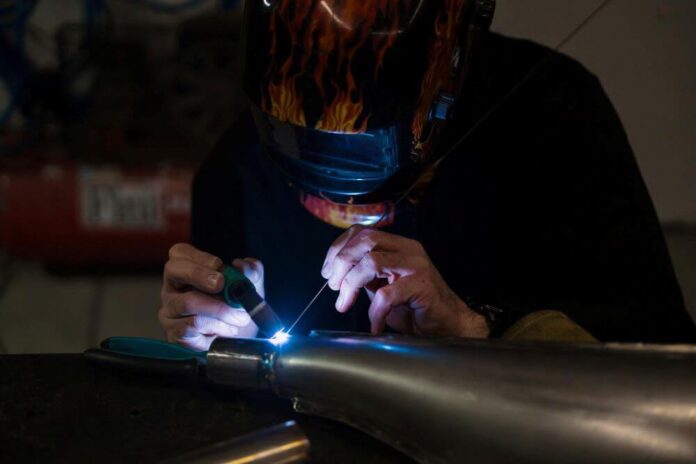
Laser welding can feel effortless when the seam looks clean, and the work moves fast. That is also when risk sneaks in. If you are unsure which eye and skin protection matches your beam, if results change because your settings are inconsistent, or if you are working in tight, cluttered spaces where reflections, fumes, and fire hazards are easy to miss, you need a routine that slows you down at the right moments. Build that routine before you pick up a handheld laser welder.
Choosing the Right Safety Approach
Denaliweld’s safety materials focus on pairing protective gear with controls that reduce exposure in the first place. They describe workstation-style shielding that uses protective laser glass for the common 1060–1100 nm range, along with a safety door interlock that can connect to the welding system. They also describe a distance-sensing feature that stops the laser when the gun head lifts or its direction changes, helping prevent accidental firing outside the weld area.
Safety Fundamentals for Laser Welders
How Laser Welding Differs from Arc
A handheld laser welder concentrates energy into a small spot, and the beam can be hazardous even when it is not visible. With arc welding, you usually manage bright light, spatter, and a broader heated area. With lasers, you also manage beam direction, reflections, and who can enter the work zone while the system is enabled.
| Safety Factor | Handheld Laser Welding | Conventional Arc Welding |
| Main exposure risk | Beam or reflection to the eyes and skin | Arc flash, spatter, heat |
| Key discipline | Beam control and restricted access | Torch control and spatter control |
| Common trap | Speed leads to rushing | Heat and cleanup slow pace |
Heat-Affected Zone and Distortion Control
Laser welding often produces a smaller heat-affected zone than many traditional methods, reducing distortion. Distortion still happens when metal expands and contracts as it heats and cools. You reduce it by fixing the workpiece so you are not holding alignment with your hands, and by stopping when gaps change instead of pushing through.
Speed and Workflow Safety Factors
Speed is helpful, but it shortens your reaction time. When you move too fast, it is easier to miss a drifting standoff distance or a changing gap. Treat speed as a setting, not a goal. If visibility or access is not ideal, slow down and reset before you continue.
Pre-Operation Planning and Site Controls
Workspace Setup for Tight Access
Clear reflective clutter near the beam path, and cover or move polished tools and shiny offcuts. Define a boundary to keep only trained personnel inside the work zone. Plan your starts and stops so the tool stays pointed safely during repositioning. If the job is tight-access, reposition the part instead of twisting your body into a weak stance.
Material and Joint Planning
Clean off oil, paint, and residues that can smoke or flare. Confirm the joint type and gap, then decide whether filler is needed and where your off-hand will be while feeding. Run a short test on scrap that matches the same thickness and joint geometry. Adjust one parameter at a time and record what changed.
Environmental Limits and Readiness
Make sure ventilation matches the material and any coatings present. Keep combustibles away from the work area and keep a fire extinguisher within reach. Also, respect the operating limits listed for your equipment. Condensation, rain, unstable power, or extreme temperatures can trigger alarms or unpredictable behavior.
Operator Competency and Parameter Control
Training and Supervised First Runs
Start with dry runs to practice angle, distance, and posture without firing. Then do supervised test welds on scrap before moving to real parts. Keep a clear stop rule: if you lose sight of the seam, if your stance breaks down, or if someone enters your zone, you stop and reset.
Adjusting Settings with Controls
Most systems let you tune power and other parameters through controls or software, and you should use that flexibility carefully. Denaliweld notes that handheld units commonly use software controls to adjust laser parameters, and it describes a compact unit weighing 48.5 pounds that is rated for continuous operation from -10°C to 45°C. It also describes double emergency stop buttons located on the machine and on the gun head, intended to stop the system immediately in an emergency. Use details like these as prompts to verify your own machine’s limits and safety devices before you weld.
Staying within Safe Output
Start conservatively and increase output only as needed for stable fusion. Working inside a known range reduces blow-through and reduces rework. It also reduces the temptation to lean in for a closer look, which is a common way people break beam discipline.
Safe Handling during Welding
Controlled Movement and Beam Discipline
Brace your forearms when you can, keep a consistent standoff distance, and track the seam with small controlled motions. When you reposition, release the trigger first, move with the tool aimed safely, then re-acquire the seam before firing again. Confirm that any clamp, interlock, or enabling feature is correctly connected before you begin.
Managing Pace Without Rushing
Rushing shows up at corners and restarts. Slow down enough to confirm alignment at each transition. If you notice yourself speeding up to finish, pause and reset your stance.
Post-Weld Handling and Rework
Put hot parts in a designated cooling area so you do not grab them by habit. If rework is needed, treat it like a new job. Re-check barriers, ventilation, and access control, because those are the steps people tend to skip when they are just fixing one spot.
Maintenance Practices That Support Safety
Routine Cleaning and Dust Control
Dust and residue affect airflow, optics, and visibility. Keep the work area clean and follow your manual for filter and intake cleaning, protective lens care, and consumable replacement.
Inspection Cadence and Parts Replacement
Before each job, inspect the nozzle and protective lens condition, check cables and connectors for wear, and confirm that the trigger and emergency stops work correctly. Replace consumables on schedule rather than waiting for quality to degrade.
Documentation and Compliance Signals
Track training completion, parameter baselines for common materials, maintenance actions, and PPE checks. When something changes, you can see what was adjusted and why.
Conclusion
Safety with laser welding comes from control and consistency. If you keep the workspace predictable, tune parameters methodically, and maintain the tool so it behaves consistently, you protect yourself and your results. If you are updating a shop procedure, Denaliweld’s published laser safety guidance can help you double-check your controls and training steps. Carry these habits into your next handheld laser welder job, so your speed never outruns your safety.


